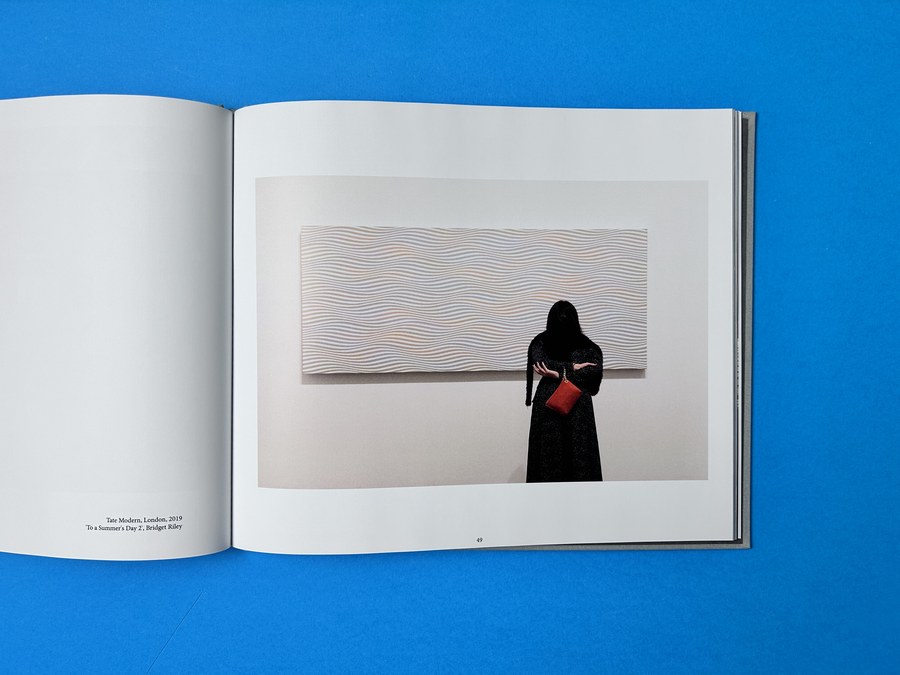
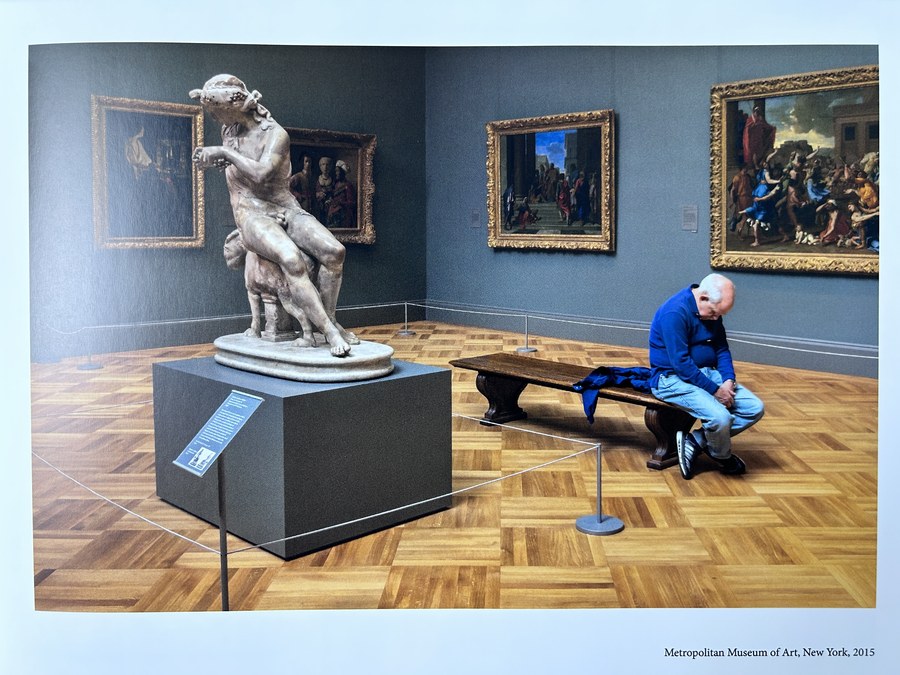
Some photo books are about the art. Francesco Marchetti’s is about the people standing in front of it: a woman in black, face hidden by her hair, holding a red bag before a Bridget Riley; a man in a blue jacket on a gallery bench, eyes on his phone while a marble group writhes above him at the Met. The Art of Spectating collects years of these small encounters in London, New York and other cities, and our team turned it into a landscape hardback in 2021.
The photographs on this page were taken two summers later, in August 2023. Two years is a fair test for any hardback, so this page walks round the book from its cloth to its captions.
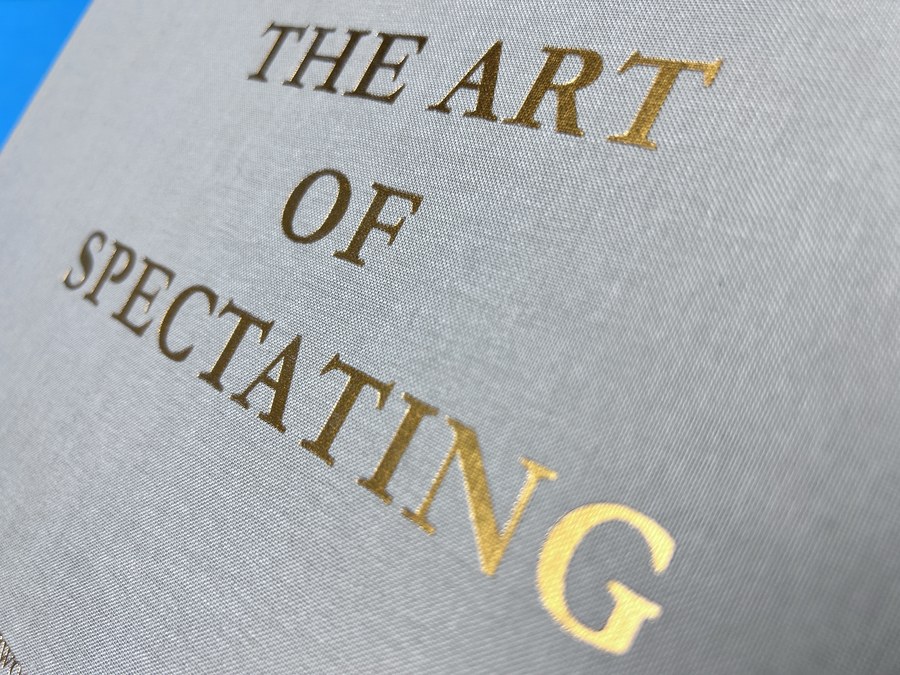
Pale grey book cloth with a fine linen weave covers the boards, chosen by Francesco from physical samples rather than a screen. Across it, in gold foil, the title is stacked in three lines of classical serif capitals, set in Garamond bold at 65pt, with his name above in the same face and the foreword credit below in a lighter weight. Look closely at the hero shot and you can see how foil behaves on cloth: it sits down into the weave and breaks very slightly over the raised threads, so the letters glint as you tilt the book instead of lying flat like ink.
Francesco picked the foil from a physical sample too, specifying his gold by its code, and it sits easily on the grey. The same gold runs along the 13mm spine, so the title reads on a shelf. If you want a cover that rewards a closer look, a single foil colour on a textured cloth will do more than a full colour print, and two years on this one still glints. Our page on cloth and linen covered hardbacks shows more combinations.
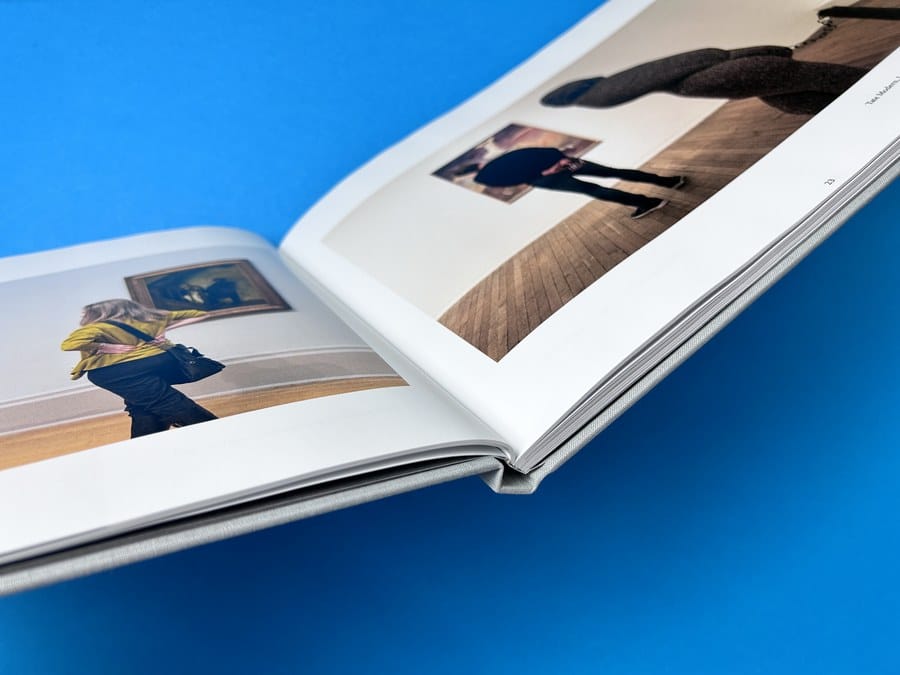
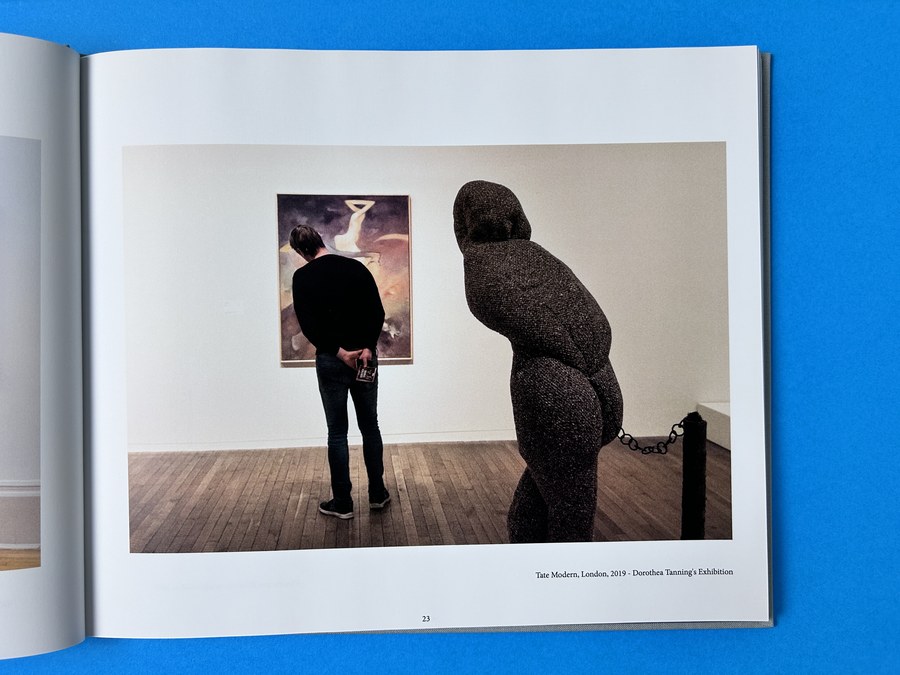
Open the case and the format explains itself. At 297 x 250mm, wider than it is tall, a spread gives a gallery photograph its walls, floor and ceiling as well as the visitor, which is where much of the humour lives. A man in black studies a painting while a huge, knobbly dark sculpture looms beside him; the picture needs that width to land the joke.
The layout is generous with white space. Most photographs sit inside clean margins on one page, a few run full bleed to the edges, and nothing is cropped tight. For street and documentary work, a landscape page often suits the pictures better than an upright one. Have a look at our photo book printing options to compare sizes.
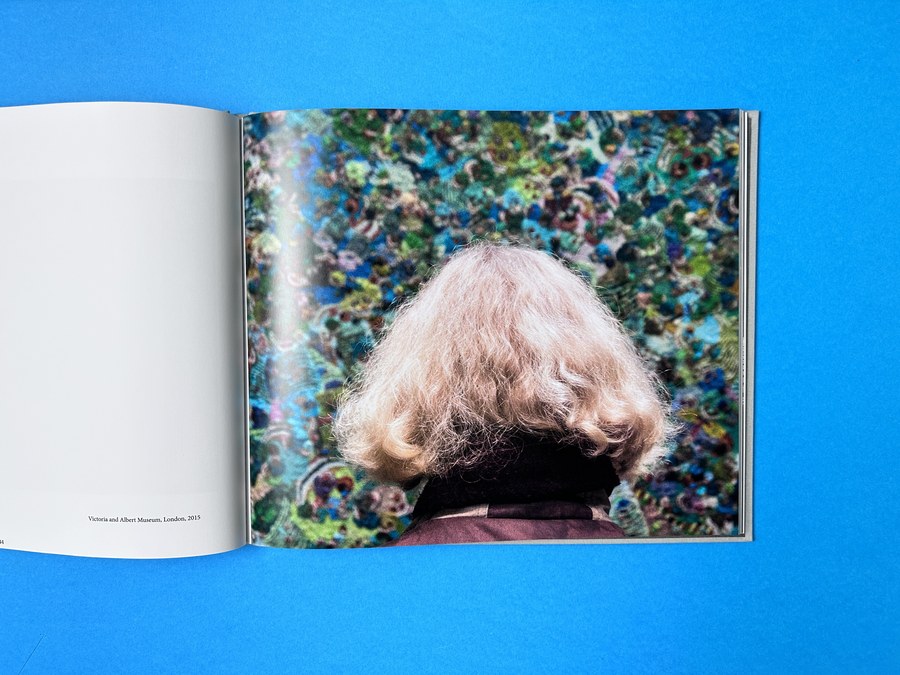
The rhythm of the book is simple and confident. A photograph sits on one page; its caption sits on the facing page, small and set in a serif, giving the place, the year and, where an artwork is shown, its title and artist. “Tate Modern, London, 2019” faces a woman before a wavy striped painting. “Victoria and Albert Museum, London, 2015” faces a full bleed image of a head of fair hair against a dense, many coloured textile.
Keeping captions off the image leaves each picture uncluttered, so the reader looks first and reads second, the same order a gallery visit follows. You could try it in your own photo book: give the caption its own page, align it low and to the edge, and resist adding anything else.
Inside, the pages are 170gsm silk. The smooth surface holds the saturated stripes of a Riley and the deep shadows of a dim old master room with the same accuracy, and the faint sheen picks up a soft band of light across the full bleed spreads, much as a gallery wall catches a spotlight. At that weight each leaf has enough body to turn cleanly, and the block fans open in a neat curve from the square backed case, as the angled shot shows. Printed endpapers on 170gsm uncoated sit between the boards and the first photographs.
Francesco designed the whole book himself in InDesign, and his reaction a year after publication says plenty about how it was received:
It has been a pleasure working with Ex Why Zed last year and the quality has blown everyone away !!!
Francesco, photographer and author of The Art of Spectating
That message also carried news: the book had won a photo book competition and been recognised by the Royal Photographic Society in its book category. Planning a cloth hardback for your own photographs? See how a case bound book is made, then send us your format and page count.