


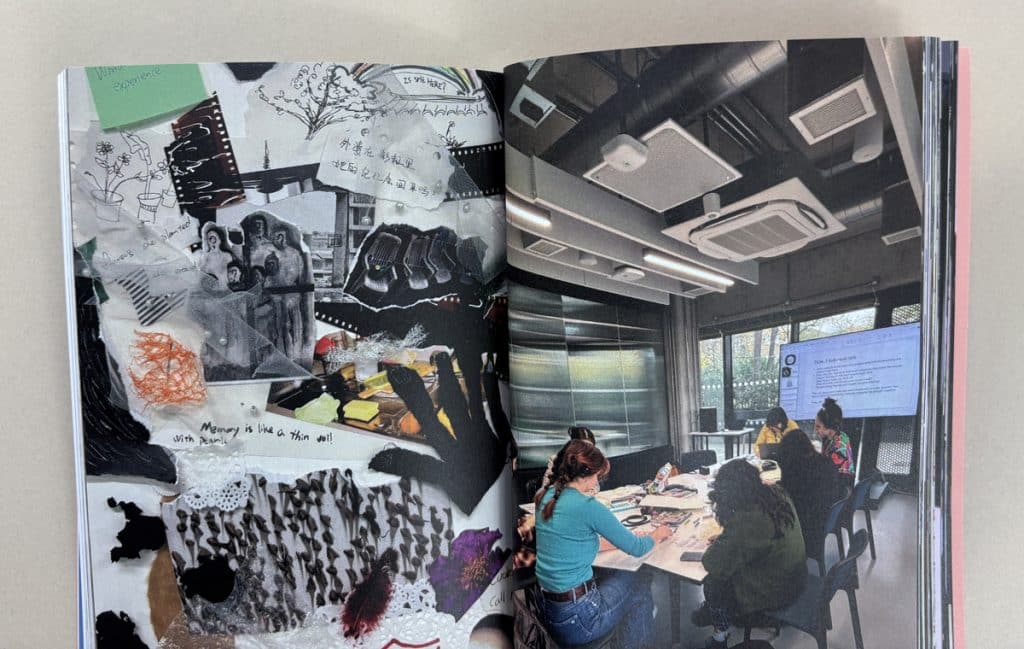
Key Highlights
- A design portfolio is your most powerful tool for showcasing your skills, visual identity, and creative thinking.
- Curating your strongest work helps you make a sharper, more memorable impression.
- Detailed case studies and clear project descriptions reveal your process and problem-solving approach.
- A user-friendly, visually consistent layout ensures your portfolio feels professional and easy to navigate.
- Different design fields require tailored portfolio styles, from UX case studies to interior or fashion storytelling.
- Creating an online design portfolio helps you reach more clients through a polished, accessible digital format.
- Keeping your portfolio updated regularly shows growth, commitment, and evolving design expertise.
- A printed, professionally bound portfolio from Ex Why Zed can elevate your presentation and leave a lasting impression.


Every designer wants their work to be noticed, but standing out in a crowded creative industry can feel incredibly challenging. Even with strong ideas and polished skills, your work can fall flat if it isn't presented with clarity and intention. That disconnect often leads to frustration; you know you're capable, yet your current presentation doesn't fully reflect your talent.
The struggle usually begins with figuring out what to include, how to organise your projects, and how to express your process without overwhelming the viewer. Many designers also feel unsure about how to shape a narrative that feels cohesive, professional, and true to their design style, especially when starting from scratch or updating an outdated portfolio.
This blog will walk you through how to create a design portfolio that genuinely represents your abilities, strengthens your personal brand, and helps you stand out with confidence, both online and in print.
What Makes a Design Portfolio Essential for Your Creative Career Today?


A well-crafted portfolio shapes how the world sees you as a designer. Before we explore the deeper sections, here are the key ways your portfolio plays a crucial role in elevating your creative career, whether it's presented digitally or as a beautifully finished printed book with perfect binding for a polished, professional feel:
- Establishes Your Creative Identity: Your portfolio expresses your style, thinking, and visual voice, giving people a clear sense of who you are as a designer.
- Helps Aspiring Designers Break Into the Industry: Self-initiated projects and redesigns show your ability to create purposeful work even without client briefs.
- Becomes the Centrepiece of Your Professional Brand: A strong portfolio shows your evolution, making it easier for clients to trust your expertise and creative direction.
- Demonstrates How You Solve Real Problems: Case studies reveal your process, from research to refinement, proving you can think strategically, not just aesthetically.
- Shows Your Versatility and Strengths Clearly: Curated projects highlight the range of styles or disciplines you work in, helping clients decide if you're the right fit.
- Acts as Your Visual CV: Instead of listing responsibilities, your portfolio shows real outcomes, giving employers a richer understanding of your abilities.
Which Elements Are Crucial for a Professional Design Portfolio?


A portfolio only makes an impact when its structure supports the work inside it. To help you build one that feels clear, confident, and well-thought-out, here are the key elements every designer should include:
- A Curated Selection of Your Best Projects: Choose quality over quantity by highlighting the most relevant work that represents your strongest creative skills. Whether you're experienced or just starting, focus on pieces that align with the roles or clients you want to attract.
- Clear and Insightful Project Descriptions: Go beyond visual elements by explaining the brief, your crucial role, the challenges involved, and the outcomes. These short narratives help viewers understand your thinking and the value you brought to the project.
- A Transparent Look at Your Design Process: Include moodboards, early sketches, wireframes, drafts, prototypes, and explorations. Showing how your ideas evolved builds trust and demonstrates that you can think critically, not just design beautifully.
- Consistent Layout and Visual Styling: Cohesive colours, typography, spacing, and layout rhythm make your portfolio feel polished. Clean navigation and thoughtful structure ensure your work is easy to browse and leaves a strong impression.
- Accessible Contact and About Information: Make it simple for viewers to get in touch or learn more about your background. A clear bio, links to your digital portfolio website menu or socials, and a visible email help build trust and open opportunities.
- Smooth, User-Friendly Navigation: Whether digital or printed, a portfolio should feel effortless to move through. Simple menus, logical structure, and clean page transitions keep attention on your work, not the interface.
What Steps Should You Follow to Create a Design Portfolio From Scratch?

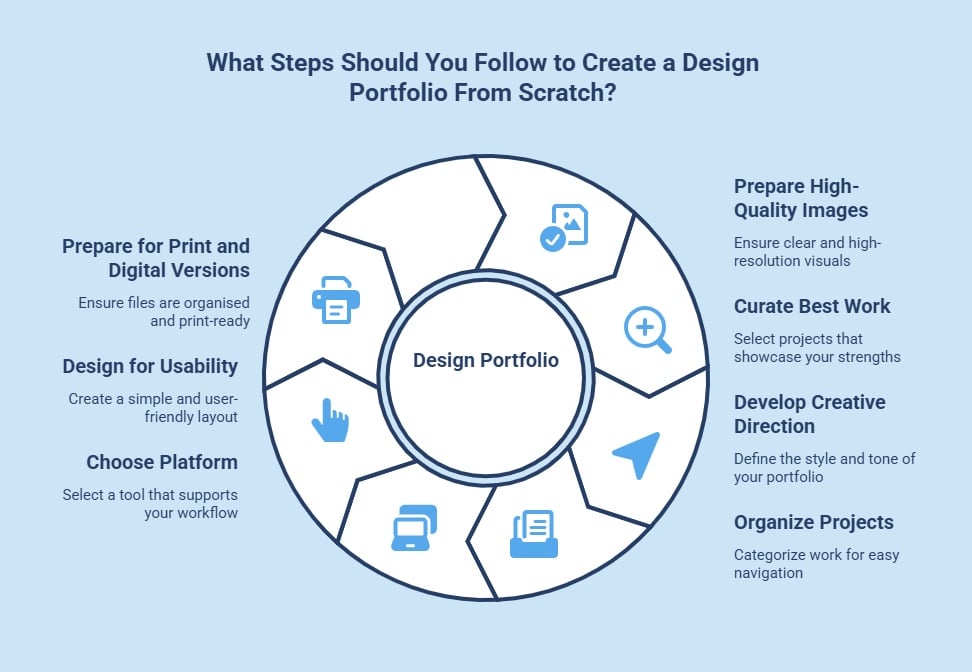
Before you begin designing your portfolio, lay the foundations so your work is easy to present both online and in print. Here are the essentials you need to start strong:
- Prepare High-Quality Images and Files: Clear photos and high-resolution exports ensure your projects look polished on screen and transition easily into a print-ready format later.
- Curate Work That Reflects Your Best Thinking: Gather academic, freelance, and personal projects, then keep only the pieces that truly represent your unique style, process, and creative strengths.
- Develop a Clear Creative Direction: Explore other designers' portfolios to define the tone and layout style you want to achieve, whether minimalist, editorial, or expressive.
- Organise Projects Into Clean Categories: Sorting your work into groups like branding, UX, interiors, or fashion helps viewers navigate smoothly and see your strengths at a glance.
- Choose a Platform That Supports Your Workflow: Website builders, portfolio platforms, or AI tools make it easy to create clean layouts you can update regularly as your work evolves.
- Design With Simplicity and Usability in Mind: Use consistent spacing, hierarchy, and short descriptions so your projects are easy to follow and leave a strong first impression.
- Prepare for Both Digital and Printed Versions: Keeping files organised and print-ready from the start makes it effortless to create a beautifully bound physical portfolio in standard paper sizes later on.
How Do You Decide What Type of Design Portfolio You Need?
The type of design portfolio you need depends heavily on your specialisation and career goals. A graphic designer might focus on branding projects and illustrations, while an interior designer will showcase finished spaces and design concepts. A UX designer targeting a product manager role, on the other hand, should emphasise case studies that detail user research and problem-solving. When creating a design portfolio, your digital showcase should be tailored to highlight the skills most relevant to your field.
Customising your portfolio for a specific job or client is a powerful strategy. Before applying for a role, research the company and identify the type of work they do. Then, adjust your portfolio to showcase the range of projects that are most relevant to their needs and style. This shows you've done your homework and are genuinely interested in the opportunity. By curating your content this way, you can demonstrate how your unique skills are a perfect fit for that specific role.
How To Create a Graphic Design Portfolio?
A professional graphic design portfolio should present your visual thinking with clarity and intention. Here are the important elements that help your work feel polished and professional:
- Select Projects That Reflect Strong Visual Strategy: Choose pieces that show purposeful decisions and a clear design rationale. This helps clients see that every choice you make serves a strategic purpose.
- Create Clear Before-and-After Comparisons: Showing the original versus your redesign demonstrates your ability to solve problems visually. It also highlights how your work improves clarity and impact.
- Use Consistent Presentation Frames for Your Work: Keeping margins, backgrounds, and mock-up styles uniform creates harmony across your portfolio. This consistency helps your projects feel part of a cohesive identity.
- Highlight Multi-Platform Applications of Your Designs: Show how a single concept adapts to print, social, and digital formats. This proves your versatility and understanding of brand systems.
- Add Short Insights on Challenges You Solved: Mention colour limitations, layout issues, or messaging constraints you worked through. These details show how you turn creative obstacles into thoughtful solutions.
How To Create an Interior Design Portfolio?
An interior design portfolio should communicate atmosphere, detail, and spatial intelligence. These points offer a great way to help you bring your spaces to life when creating an interior design portfolio:
- Present Spaces From Multiple Angles for Depth: Wide shots paired with close-ups help viewers understand both the overall layout and the details that complete the space. This reveals the fullness of your creative approach.
- Include Lighting Variations to Show Mood and Ambience: Displaying daytime, evening, and artificial lighting highlights your sensitivity to how environments shift. This demonstrates your understanding of mood and spatial experience.
- Show Sample Boards to Reveal Material Awareness: Including textures, surfaces, and colour schemes helps convey how you build atmosphere through material choices. It also shows clients your attention to physical detail.
- Explain Zoning and Layout Decisions Clearly: Discuss how you improved flow, defined functions, or maximised space usage. This communicates your ability to balance beauty with practical needs.
- Use Annotated Diagrams for Quick Visual Clarity: Adding subtle labels to images makes your expertise instantly understandable. These annotations guide viewers through your reasoning without overwhelming them.
How To Create a Web Design Portfolio?
A web design portfolio should reflect usability, structure, and modern visual design. These elements communicate your digital expertise effectively:
- Show Full User Creative Journeys Instead of Static Screens: Displaying step-by-step pathways helps viewers understand how your designs support users through tasks. It highlights your ability to create intuitive navigation flows.
- Document Accessibility Considerations You Applied: Mentioning colour contrast decisions, font sizing, or ARIA labels shows that you design with inclusivity in mind. This instantly elevates your credibility in a digital-first world.
- Create Visual Breakdowns of Your Layout Grid: Sharing the underlying grid or spacing system proves your mastery of structure. It also gives clients insight into how you maintain alignment and consistency.
- Use Animated GIFs to Display Interactions: Showing hover states, button transitions, and micro-interactions reveals your attention to detail. These small moments help define the overall user experience.
- Present Redesigns With Clear Justifications: If showcasing conceptual work, explain what wasn't working and how your changes improved clarity or usability. This shows strategic thinking beyond aesthetics.
How To Create a Fashion Design Portfolio?
A fashion design portfolio should express style, craftsmanship, and storytelling. The following points help you communicate your creative identity with depth while creating a fashion design portfolioeffectively.
- Combine Digital Illustrations With Hand-Drawn Sketches: Showing both mediums proves you can ideate through multiple techniques. This blend also gives viewers insight into how your concepts evolve.
- Show Development of Silhouettes Across Collections: Presenting early shape studies after final garments reveals your ability to refine ideas. It highlights progression and consistency in your design language.
- Use Fabric Movement Shots to Show Fit and Flow: Dynamic images demonstrate how your garments behave in motion, which is essential in fashion storytelling. They also bring energy and life to your photo portfolio.
- Create Colour and Trend Analysis Boards: Include research boards that show how you study palettes, seasons, and cultural influences. This demonstrates awareness of industry trends and design direction.
- Add Notes About Construction Challenges You Solved: Mention specific stitching choices, pattern corrections, or material adjustments. These details show craftsmanship and technical understanding.
How To Create a UX Design Portfolio?
A UX portfolio should communicate process, iteration, and user-centred thinking. So, these points help you present your skills with clarity:
- Share Problem Statements With Clear Success Metrics: Defining what you aimed to solve and how success was measured sets a strong context. It also shows that your solutions are tied to real outcomes.
- Include User Interview Highlights and Relevant Quotes: Pull short insights from your research that shaped your designs. These snippets prove you base decisions on real user behaviour, not assumptions.
- Show Multiple Iteration Rounds for Transparency: Present early sketches, mid-fidelity wireframes, and final prototypes side-by-side. This visual progression highlights your ability to evolve ideas thoughtfully.
- Explain How You Compared and Evaluated Concepts: Share why some ideas were rejected and others refined. This demonstrates strategic decision-making and your ability to prioritise user needs.
- End Each Case Study With Reflection and Learning: Briefly outline what you gained from the project or what you'd improve next time. This shows maturity and a growth mindset that employers value.
How Can You Leverage AI Tools for Portfolio Creation?
AI tools can streamline and elevate the way you build a standout design portfolio. They help you organise projects, refine layouts, and even generate clean visual mockups that enhance presentation quality. AI writing assistants can support you in crafting concise project descriptions, improving clarity without losing your creative voice. Image-enhancing tools can also correct lighting, remove distractions, or upscale visuals to ensure every project looks polished.
These tools don't replace your creativity, but they can save time and strengthen the overall impact of your portfolio. By using AI to handle repetitive tasks, you can focus more on storytelling, curation, and showcasing the thinking behind your work. When used intentionally, AI becomes a valuable partner in building a portfolio that truly stands out.
How To Create Your Online Design Portfolio?
Creating your online portfolio starts with choosing a platform that showcases your work effectively. A dedicated website gives you full control over your branding, layout, and the overall viewing experience. Tools like Wix make it easy to create design portfolio online using customisable templates, even if you don't code.
As you build your site, keep navigation simple, visuals consistent, and your contact details easy to find. While your own website offers the most creative freedom, portfolio platforms can also boost your visibility within design communities.
Platform Options to Create a Design Portfolio Online
| Platform Type | Pros | Cons |
|---|---|---|
| Personal Website Builder (e.g., Wix) | Full customisation, professional domain, integrated tools. | May have subscription costs. |
| Portfolio Platforms (e.g., Behance) | Large creative community, easy to upload projects. | Limited customisation, high competition. |
| Social Media (e.g., Instagram) | Great for visual sharing and engagement. | Not a professional portfolio format, lacks case study features. |
| Self-Coded Website | Complete creative freedom showcases coding skills. | Time-consuming, requires technical expertise. |
Although your online presence is essential, pairing it with a printed portfolio can strengthen your overall presentation. Many creative leads still appreciate the tactile experience of a well-crafted physical book, especially during interviews or detailed project reviews. Preparing your work in print-ready formats, with binding options such as wire-stitched, perfect-bound, or spiral binding, ensures you can confidently showcase your designs in both digital and physical settings.
What to Include and Avoid in a Design Portfolio?
To help you refine your selection with confidence, here's a clear look at what belongs in a strong portfolio and what's better left out.
| Include | Why It Matters | Avoid | Why It Hurts Your Portfolio |
|---|---|---|---|
| A clear introduction that defines your design focus | Helps employers instantly understand your strengths, specialism, and creative direction. | Generic introductions without a defined niche | Leaves clients unsure about your expertise or the type of work you excel in. |
| Process work that shows how your ideas develop | Reveals your thinking, problem-solving, and the evolution of your concepts. | Only showcasing polished final outputs | Makes your portfolio feel surface-level and doesn't reflect your full capability. |
| Cohesive layouts suitable for both digital and print | Ensures your portfolio is easy to browse online and ready to convert into a printed format. | Disorganised spacing or inconsistent layouts | Creates a fragmented viewing experience and weakens professionalism. |
| Short explanations centred on decisions, not tools | Demonstrates your reasoning and design maturity beyond software knowledge. | Long paragraphs that focus on software lists | Makes your work appear technical rather than strategic or thoughtful. |
| A downloadable PDF or print-ready version | Gives clients and employers an easy way to review your work offline or during meetings. | Unoptimised files that are slow or awkward to open | Signals poor attention to detail and reduces your chances in formal reviews. |
What Final Checks Should You Do Before Sharing Your Portfolio?
Before publishing your portfolio, take time for a careful final review. Treat it like proofreading a vital document. A clean, error-free portfolio reflects professionalism and strong attention to detail. Check every page to ensure visuals, links, and layouts work perfectly.
For an extra layer of polish, ask a friend, mentor, or colleague to review it. Fresh eyes can spot broken links, typos, or gaps you might overlook. This matters even more when you're about to start an application process where first impressions are everything.
Before sharing, make sure you check:
- All links are working correctly.
- There are no typos or grammatical errors in your case studies.
- Your contact details are correct and easy to find.
- Your website is responsive and looks great on mobile devices.
- All images are high-quality and load quickly.
How Can You Keep Your Portfolio Updated as Your Skills Grow?
Your portfolio should be a living document that grows with you. As you complete new projects and gain more work experience, it's important to add them to your online portfolio. This not only keeps your content fresh but also demonstrates your continuous development and evolving design skills. Set a schedule for yourself, perhaps every 3-6 months, to review and refresh your work.
Don't just add new work; also consider removing older pieces that no longer represent your best abilities or current style. Each project is a learning experience, and your digital art portfolio should reflect that growth. Regularly updating your portfolio shows potential clients that you are an active and engaged designer who is constantly honing your craft and staying current with industry trends.
What Makes Ex Why Zed the Ideal Choice for Portfolio Printing?
Once your online portfolio is complete, translating it into a beautifully printed book can add a new dimension to how people experience your work. A physical portfolio feels intentional, immersive, and memorable, offering the kind of tactile engagement that the print industrycontinues to excel at. This shift from digital to print creates a stronger connection and sets the stage for a more polished presentation.
That's where Ex Why Zed shines. Our Printed Project Builder makes it effortless to turn a simple PDF into a professionally bound portfolio, complete with free file checks, designer-led support, and beautifully finished formats. From stapled booklets to perfect-bound showcases, we help you choose the right size, paper, and structure for your style.
With fast turnaround times, free sample packs, and meticulous attention to detail, we ensure your portfolio looks every bit as polished as the work inside. If you're ready to present your creativity with confidence, now is the perfect moment to start your print journey today at Ex Why Zed and bring your portfolio to life.
Conclusion
Creating a standout design portfolio comes down to presenting your work with clarity and intention. When your projects are well-curated and supported by strong storytelling, your portfolio becomes a true expression of your creative identity and the way you think.
As your skills grow, keep refining and updating your portfolio so it evolves with you. Treat it as a living document that highlights your best ideas and aligns you with the opportunities you want.
And when you're ready to take your presentation beyond the screen, a beautifully printed portfolio can add an extra layer of impact. High-quality prints make your work feel tangible, memorable, and unmistakably professional.
Frequently Asked Questions
How many projects should I include in my portfolio?
Include 8–12 of your strongest projects to showcase range and skill. Beginners can start with 3–6 solid case studies. Focus on quality over quantity and choose work that reflects your style and aligns with your target audience.
Can you give examples of standout design portfolios for inspiration?
Great examples include designers who combine strong visuals with clear process storytelling, such as those on Behance and Dribbble. Look for portfolios with balanced layouts, well-structured case studies, and consistent branding to inspire your own approach.
How can I tailor my portfolio for specific jobs or clients?
Research the company, understand their style, and select projects that match their needs. Reorder or adjust case studies to highlight relevant strengths. This customisation shows intention, preparation, and a clear connection between your work and their expectations.
How Should You Structure Each Case Study for Maximum Impact?
Use a simple story format: define the problem, explain your role, outline your process, and present the final outcome. Include visuals that show evolution, insights, and results. This structure clearly communicates your thinking and design value.
How can I create a design portfolio if I'm just starting out and have no client work?
Create personal projects, redesign existing brands, or participate in design challenges. These self-initiated pieces demonstrate creativity, skill development, and passion. They effectively showcase your process and thinking, even without formal client work.
How should I organise and lay out my graphic design portfolio for maximum impact?
Use a clean, consistent layout with clear sections and logical project categories. Prioritise user-friendly navigation, cohesive colours, and readable typography. This ensures viewers can explore your work effortlessly and quickly understand your strengths.
What common mistakes should I avoid when creating my design portfolio?
Avoid overcrowding your portfolio with outdated work or writing long, unclear descriptions. Check for broken links, typos, and confusing navigation. These mistakes weaken professionalism and distract from your strongest projects.
What is the best way to showcase my process and skills in a portfolio?
Present your process through sketches, moodboards, iterations, and prototypes. Explain design decisions and highlight challenges you solved. Showing evolution and reasoning helps clients understand your approach and strengthens the impact of your final work.
How to create a good design portfolio?
A good portfolio highlights your best work, uses clear case studies, and reflects your personality. Focus on strong visuals, simple navigation, and concise descriptions. Make sure your contact details are accessible so viewers can easily reach you.
Should you include personal projects or only client work?
Include both of them. Personal projects showcase curiosity, passion, and experimentation, while client work demonstrates professionalism and real-world application. Together, they create a balanced, authentic picture of your abilities and creative growth.